
CPQ to Revenue Cloud Migration
Salesforce CPQ went end-of-sale in March 2025. It still runs, but new capability lands in Revenue Cloud Advanced and Revenue Cloud Billing, the quote-to-cash platform under Agentforce Revenue Management. Moving is a migration rather than an upgrade: the data model, the pricing engine and the quote calculator scripts all change. We assess your org, run the migration with an accelerator built for it, and cut over in phases with rollback at every step.
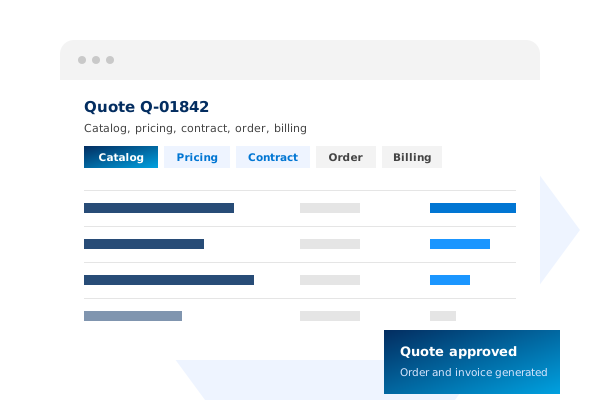
CPQ Orgs Are Customised. Revenue Cloud Is a Different Model
Years of price rules, product rules, user-defined fields, bundles, quote calculator scripts and downstream integrations sit in your CPQ org. Revenue Cloud Advanced runs on the core platform with a unified product catalog, pricing procedures, constraint-based configuration, contracts, orders and assets, and exposes every step through APIs, Agentforce actions and partner portals. Its model does not map one to one from a CPQ managed package.
- Some CPQ configuration records become several Revenue Cloud records plus metadata. The mapping has to say where and how.
- Some CPQ features have no Revenue Cloud equivalent and need custom configuration or Apex to survive.
- Some features no longer make sense and should be dropped for the better Revenue Cloud pattern, with a plan for each.
- Quote calculator scripts do not port. Each one has to be read, understood and either mapped to a native feature or rewritten.
That is why the work runs in three stages, each producing something your team can review before the next one starts.
Three Stages. Your Team Decides, The Accelerator Does the Mechanical Work
Assessment
Metadata only, no data touched. We connect to your CPQ org, inventory every artefact and produce a functional and technical prescription for each one: map, transform, rebuild or drop. It is usable on its own if you want to migrate by hand.
Migration Accelerator
A configuration-driven engine applies the prescriptions. Where a client decision is needed, the pipeline stops, pre-populates a spreadsheet with the options, and resumes when it comes back. Pause, resume and retry are built in. Same-org and cross-org migrations are both supported.
Data and Cutover
Phased loads with partial loads and rollback. Relationships and hierarchies are preserved, target validations are held off during loads, and a temporary compatibility interface keeps downstream integrations working while you re-point them.
Two Parts of Every CPQ Org Need Their Own Plan
Scripts and billing do not move with the rest of the configuration, so each gets its own track inside the three stages.
Quote Calculator Scripts
Scripts are code rather than configuration. They carry pricing and validation logic that no mapping table can move, and they are where migrations usually go wrong. Every script is analysed by AI, then reviewed by an engineer, and classified: replace with a native Revenue Cloud feature, or rewrite for a custom calculation engine we maintain. You get the classification and the reasoning before any code is written.
Billing
CPQ Billing shares objects with quoting but runs its own invoicing, payment and revenue schedules, so moving both at once doubles the risk. It moves to Revenue Cloud Billing as its own phase after quoting, on the same engine, so the quote-to-cash chain is never half-moved.
What You Get
- Assessment report: every artefact, its prescription and the reasoning
- Migration plan with an order of execution and the decisions your team owns
- The accelerator run against your org, with every decision captured
- Cutover runbook, rollback points and a compatibility interface for integrations
- Knowledge transfer: your admins can explain the new model, not just operate it
- The migration handbook in full, and thirty days of support after cutover, inside the price
Most of that list is what other firms call change requests. Here it is the scope.
Read the Migration Handbook Before You Plan the Move
Every CPQ object and field and where it lands in Revenue Cloud, including what splits and what merges. The features with no equivalent and what to do about each. The Revenue Cloud features that need net-new setup. How quote calculator scripts are classified for migration. Written by the team building the accelerator, and free to read.
CPQ to Revenue Cloud Migration: Questions We Are Asked
Is Salesforce CPQ end of life?
No. End of sale, since March 2025: Salesforce has stopped selling it to new customers. Existing customers can keep it, add users, renew and get support. New features only go into Revenue Cloud Advanced, which Salesforce names as the successor. No retirement date has been announced and nobody is being forced to migrate.
Can Salesforce CPQ be upgraded to Revenue Cloud in place?
There is no upgrade path. CPQ keeps its quotes on package objects (SBQQ__Quote__c and friends); Revenue Cloud Advanced uses the standard Quote and Order objects, a different pricing engine and a different configurator. Each CPQ artefact has to be mapped, transformed, rebuilt or dropped, quote calculator scripts have to be replaced or rewritten, and billing moves as a separate phase. Same-org and cross-org migrations are both supported.
How long does a CPQ to Revenue Cloud migration take?
The assessment is two weeks, fixed price and fixed scope. The migration itself depends on four things: how customised the CPQ org is, how many quote calculator scripts it carries, whether CPQ Billing is in scope, and how many integrations read quote data. The assessment ends with a plan and an order of execution sized for your org, which is the only version of this answer worth having.
What happens to quote calculator scripts?
They do not port. Scripts are code, not configuration. They carry pricing and validation logic that no mapping table can move, and they are where migrations usually go wrong. Every script is analysed by AI, then reviewed by an engineer, and classified: replace with a native Revenue Cloud feature, or rewrite for a custom calculation engine we maintain. You get the classification and the reasoning before any code is written.
Does CPQ Billing move at the same time as quoting?
No. CPQ Billing shares objects with quoting but runs its own invoicing, payment and revenue schedules, so moving both at once doubles the risk. Billing moves to Revenue Cloud Billing as its own phase after quoting, on the same engine, so the quote-to-cash chain is never half-moved.
What do we keep if we do not migrate with Crystal Lotus?
Everything the assessment produces: the per-artefact migration prescription for your CPQ org and the plan with its order of execution. The assessment touches metadata only, no data, and is usable on its own if you migrate by hand or with another partner. If you go ahead with us, the assessment fee is credited against the migration.
Included in Every Engagement, at No Extra Cost
The things most firms charge for, or quietly leave out. You get them as standard, and your team keeps all of it.
A Named Architect for the Whole Engagement
The person who designs your solution stays on it to the end and joins every review. No hand-off to a rotating bench.
A Decisions Log and Architecture Diagrams
Every choice written down with the reason, so six months later nobody has to guess why the org looks the way it does.
Working Demos Every Week
You see running software each week and steer while it is cheap to change. No status decks.
Everything in Version Control
Metadata, pipelines, packaging and tests from the first sprint. Your org can be rebuilt, audited and handed to anyone.
Documentation, Runbooks and Knowledge Transfer
Your admins can explain the design, not just operate it. We are not building a dependency on us.
Thirty Days of Post-Go-Live Support
After go-live the team stays available for a month to fix, tune and answer questions, inside the original price.
Start with the Assessment. You Keep the Plan Either Way
Two weeks, fixed price, fixed scope. You get a per-artefact migration prescription for your CPQ org and a plan with an order of execution, both yours to keep whether you migrate with us or on your own. If you go ahead with us, the assessment fee is credited against the migration.