
Agentforce and Data 360
Agentforce puts AI agents to work inside Salesforce: they read a case, look up an entitlement, draft a renewal or explain a price, and hand the result to a person for approval. They are assembled in Agent Builder from topics and actions and grounded in Data 360, and their quality depends on the actions and data underneath. That is the layer we engineer: safe actions, trustworthy data, and tests that catch a bad answer before a customer sees it.
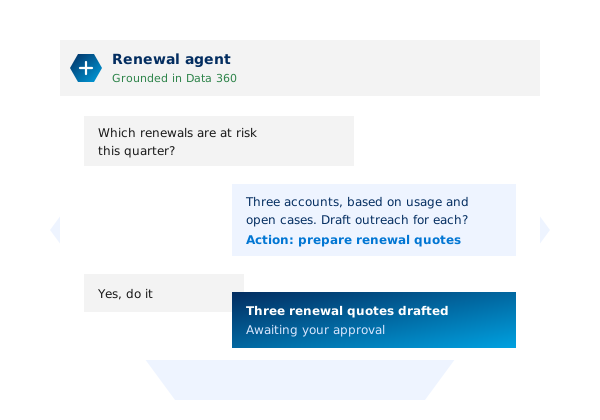
Agentforce: Agents That Do Something, Safely
Actions
Invocable Apex, flows, prompt templates and API actions that give agents something safe to do: look up entitlements, explain a price, draft a renewal, open a case with the right routing.
Topics and Instructions
Agent topics scoped to what the business has agreed, with instruction sets written and version-controlled like code.
Guardrails and Tests
Batches of real conversations run in Agentforce Testing Center and in our own harness on every release, so a change in a prompt template is caught before a customer sees it.
Revenue Agents
Agents on Revenue Cloud that prepare renewals, explain how a price was reached and answer billing questions, so reps and finance get the answer without leaving the record.
Data 360: The Data Foundation Under Every Agent
Data 360, formerly Data Cloud, unifies data from every source into profiles that Agentforce and your people can act on.
Ingestion and Zero Copy
Data streams from Salesforce and the systems around it, and Zero Copy access to your warehouse or lakehouse so nothing is duplicated, mapped to the standard model with the lineage documented.
Identity Resolution
Match and reconciliation rules tuned on your data into unified profiles, with the merge decisions explained rather than left to defaults.
Calculated Insights and Segments
The metrics an agent or a rep needs at the moment of a conversation, and the segments marketing and service act on.
Grounding for Agents
Structured records and unstructured documents retrieved from Data 360 as the source agents answer from, so responses come from your data rather than the model's guess.
We Offer a Two-Week Readiness Assessment, Then One Agent in Production
We look at the data an agent would need, the actions it would take and the risks of each, and come back with a written scope, a risk register and a cost estimate for one agent that pays for itself. You keep all three whether or not we build it. Then we build that one, with your team watching every decision, and hand over the actions, the prompt templates and the test harness so the second agent is yours to build if you want it that way.
Agentforce and Data 360: Questions We Are Asked
What do we need in place before building an Agentforce agent?
Three things, before any building: the data the agent would read, the actions it would take, and the risk attached to each action. That is what the two-week readiness assessment looks at. It ends with a written scope, a risk register and a cost estimate for one agent that pays for itself, and all three are yours whether or not we build it.
How do you stop an agent giving a customer a wrong answer?
Ground it, scope it, test it. The agent answers from Data 360, so the response comes from your records and documents, not from whatever the model thinks is plausible. Its topics are limited to what the business has signed off, with the instruction sets kept in version control like any other code. And on every release, batches of real conversations are replayed in Agentforce Testing Center and in our own harness, so a changed prompt template gets caught before a customer sees it.
Is Data 360 the same as Data Cloud?
Same product, newer name. Data 360 is what Salesforce now calls Data Cloud. It unifies data from every source into profiles that agents and people can act on, with Zero Copy access to a warehouse or lakehouse so nothing is duplicated, identity resolution tuned on your data, and calculated insights and segments for the moment of a conversation.
Which Salesforce clouds do you run agents on?
Revenue Cloud, Service Cloud and Sales Cloud. Revenue agents prepare renewals, explain how a price was reached and answer billing questions without leaving the record. Service and sales agents resolve cases or prepare renewals, with guardrails you can explain.
What do we keep after the first agent goes live?
The actions, the prompt templates, the instruction sets and the test harness. Your team will have sat in on every decision along the way, so if you want to build the second agent yourselves, you can.
Included in Every Engagement, at No Extra Cost
The things most firms charge for, or quietly leave out. You get them as standard, and your team keeps all of it.
A Named Architect for the Whole Engagement
The person who designs your solution stays on it to the end and joins every review. No hand-off to a rotating bench.
A Decisions Log and Architecture Diagrams
Every choice written down with the reason, so six months later nobody has to guess why the org looks the way it does.
Working Demos Every Week
You see running software each week and steer while it is cheap to change. No status decks.
Everything in Version Control
Metadata, pipelines, packaging and tests from the first sprint. Your org can be rebuilt, audited and handed to anyone.
Documentation, Runbooks and Knowledge Transfer
Your admins can explain the design, not just operate it. We are not building a dependency on us.
Thirty Days of Post-Go-Live Support
After go-live the team stays available for a month to fix, tune and answer questions, inside the original price.
Ready to Talk to an Architect?
A 30-minute call with the architect who would own your work. You leave with a written view of the next step and a rough sizing, whether or not you go ahead with us.
Book an Architecture Discovery Callor email contact@crystallotus.co