
Experience Cloud Portals
Experience Cloud builds portals, help centres and partner sites on the same data as your CRM, with Lightning Web Runtime for speed and design freedom. The hard part is never the page layout. It is who can see what, at what volume, in which country.
Where We Have Done It
-
Third-Party Risk and Due Diligence Portal
Internal sponsors, supervisors and chief officers on one side, third-party contacts on the other. Configurable questionnaires, auto-generated red flags and risk matrices, translations driven by configuration. Five client implementations from one codebase, each a new org.
-
Data Residency for Regulated Records
Regulated fields and files stored in-country and redacted for everyone else, decided per record and per user. Both the Salesforce side and the residency service the client hosts.
-
Loan Application Portal for a Lender
Applicants, co-borrowers and five internal teams working a staged application, with credit bureau, KYC, eligibility, bank verification and third-party loan integrations. Loan processing time roughly halved.
-
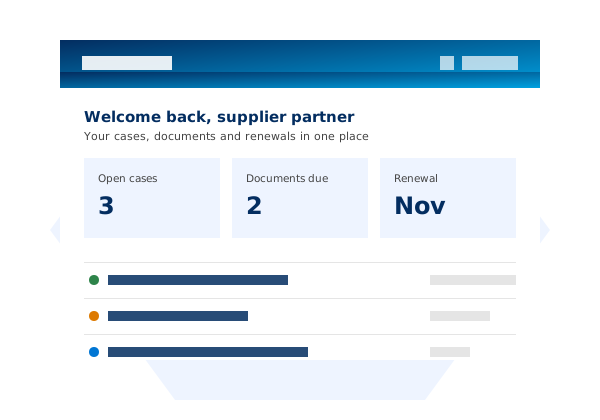
Partner and Supplier Portal on Service Cloud
Categories by user type and region, cases from the portal and by email, regional queues, SLA milestones that pause while the customer is asked for information, two-stage escalation. US and EMEA, 1,000+ internal users.
The Eleven Things That Decide Whether an External Portal Works
Each one is checked and written up before you sign, not discovered after go-live. The licence comparison is done first, because it can change which seats you buy.
Sharing and Visibility
External users see exactly their records, at scale, without sharing rules that collapse under volume.
Guest User Hardening
Public pages that expose nothing they should not, checked against every Salesforce guest-access change.
Identity
SSO with your identity provider, self-registration where it belongs, and user provisioning that carries the attributes your access rules need.
Licence Model
Customer, partner or login-based licences chosen on cost and capability, with a side-by-side cost comparison written down before you sign, so you never pay for seats you do not use.
LWR or Aura
The right template for the lifespan of the site, and a migration path when the answer changes.
Beyond the Standard Record UI
Custom components where the standard experience stops, built as a design system your team can extend without coming back to us.
Residency, Redaction, Regulated Records
Country rules enforced on the server and mirrored on the client, and nothing automated depends on data the user cannot see.
Performance at External Volume
Governor limits planned for, not discovered. Custom implementations where standard features would not hold at scale.
Localisation
Multi-language and multi-currency from configuration, including emails and generated documents.
Accessible, On Any Device
Keyboard, screen reader and phone-sized layouts tested, not assumed.
Branding
A portal that looks like your corporate site, with one design serving many client orgs where that is the business model.
Experience Cloud Portals: Questions We Are Asked
Which Experience Cloud licence should we buy?
Customer, partner or login-based licences, chosen on cost and capability for your mix of users. We write the side-by-side cost comparison before you sign, because the licence model can change which seats you buy. It is the first of the eleven things we check on every portal.
LWR or Aura?
The right template depends on the lifespan of the site and what it has to do. Lightning Web Runtime gives speed and design freedom for new builds; Aura is the template behind many established portals, including the due diligence portal we run five implementations of. We choose per site and document a migration path for when the answer changes.
Can an Experience Cloud portal keep regulated data inside a country?
Yes. Regulated fields and files are stored in a residency service inside the country and shown only to users entitled to see them, with redaction enforced on the server and mirrored in the browser. We have this live in China for a due diligence programme and designed both the Salesforce components and the residency service the client hosts.
How do you keep a portal fast with thousands of external users?
The sharing model is designed for volume from the start, so external users see their own records without sharing rules that fall over under load. Governor limits are planned for instead of discovered. And where a standard feature would not hold at scale, we build a custom implementation and say so up front.
Have you built portals like ours before?
The third-party risk and due diligence portal runs five client implementations from one configurable codebase with over 1,000 internal users at one client. Team experience includes a loan application portal for a lender, with credit bureau, KYC and bank verification integrations, and a partner and supplier portal on Service Cloud across the US and EMEA.
Included in Every Engagement, at No Extra Cost
The things most firms charge for, or quietly leave out. You get them as standard, and your team keeps all of it.
A Named Architect for the Whole Engagement
The person who designs your solution stays on it to the end and joins every review. No hand-off to a rotating bench.
A Decisions Log and Architecture Diagrams
Every choice written down with the reason, so six months later nobody has to guess why the org looks the way it does.
Working Demos Every Week
You see running software each week and steer while it is cheap to change. No status decks.
Everything in Version Control
Metadata, pipelines, packaging and tests from the first sprint. Your org can be rebuilt, audited and handed to anyone.
Documentation, Runbooks and Knowledge Transfer
Your admins can explain the design, not just operate it. We are not building a dependency on us.
Thirty Days of Post-Go-Live Support
After go-live the team stays available for a month to fix, tune and answer questions, inside the original price.
Ready to Talk to an Architect?
A 30-minute call with the architect who would own your work. You leave with a written view of the next step and a rough sizing, whether or not you go ahead with us.
Book an Architecture Discovery Callor email contact@crystallotus.co